


When people ask how many right angles does a diamond have, the answer depends on whether they are talking about the geometric shape or a real gemstone. In geometry, the familiar diamond shape is usually a rhombus. A standard rhombus has four equal sides but does not usually have any right angles. Only a special type of rhombus called a square has four right angles.
When discussing jewelry, the answer changes completely. A cut diamond is a three-dimensional gemstone made of multiple facets, not a flat geometric figure. Instead of focusing on right angles, jewelers evaluate a diamond by its proportions, symmetry, cut quality, and diamond anatomy. Parts such as the table, crown, pavilion, culet, and what is the girdle of a diamond all influence how the finished stone appears.
Whether you're studying geometry, shopping for an engagement ring, or simply curious about diamonds, understanding both the mathematical shape and the gemstone's structure helps avoid common confusion. This article explains how many right angles does a diamond have, how many sides does a diamond have, ideal proportions, and every important part of a diamond in simple language.
Diamond Shape in Geometry
Many people picture a diamond as the shape found on playing cards or road signs. Mathematically, this shape is usually called a rhombus.
A rhombus has several important characteristics:
- Four equal sides
- Opposite sides are parallel
- Opposite angles are equal
- Diagonals cross at right angles
- The diagonals bisect each other
One common misunderstanding is believing that a rhombus always contains right angles.
The truth is different.
Most rhombuses have two acute angles and two obtuse angles. Since none of these equal 90 degrees, the shape contains zero right angles. Only when all four interior angles measure exactly 90 degrees does a rhombus become a square.
Therefore, the answer to how many right angles does a diamond have is:
- Typical diamond (rhombus): 0 right angles
- Square: 4 right angles
This distinction explains why geometry textbooks separate rhombuses from squares even though every square is technically a rhombus.
Is a Diamond Shape the Same as a Rhombus?
In geometry class, the shape most people call a "diamond" is technically a rhombus: a four-sided figure where every side is the same length and opposite sides run parallel to each other. That's also the outline printed on a deck of cards for the diamond suit. A rhombus is closely related to a kite and a parallelogram, but it has one requirement the others don't: all four sides have to match in length.
Because of how a rhombus is built, its angles form two matching pairs. Two opposite corners are acute, meaning under 90 degrees, and the other two opposite corners are obtuse, meaning over 90 degrees. Add all four angles together and you always get 360 degrees, same as any four-sided figure, but none of the four corners lands exactly on 90 degrees unless the shape stops being a stretched-out diamond and becomes something else entirely.
How Many Sides Does a Diamond Have?

A geometric diamond has four sides, matching its four corners. That part is simple. Gemstone diamonds are less consistent, because the word "diamond" in jewelry refers to the mineral itself, not one fixed outline. The number of sides on a cut diamond depends entirely on which shape the cutter chose to follow, and this is also where shape and cut get mixed up. Shape refers to the outline, such as round or princess. Cut refers to how the facets are arranged and angled within that outline, which is why two round diamonds can look different from each other even though both share the same four-sided-versus-curved distinction.
A princess cut lab created diamond ring features a princess cut diamond that keeps four straight sides and four sharp corners, so it looks close to the geometric square version of a diamond rather than the elongated rhombus. An emerald cut or asscher cut diamond starts from a rectangle or square, then has each corner sliced off, which turns four sides into eight. A cushion cut or an antique old mine cut rounds those corners instead of slicing them flat, so while the general outline still traces back to four sides, the corners themselves curve rather than meet at a point.
Right Angles in Different Diamond Cuts
| Diamond Shape | Outline Sides | Corner Style | True Right Angles |
|---|---|---|---|
| Princess | 4 | Sharp, uncut | Yes, 4 |
| Emerald | 8 (rectangle with trimmed corners) | Trimmed at an angle | No |
| Asscher | 8 (square with trimmed corners) | Trimmed at an angle | No |
| Radiant | 8 | Trimmed at an angle | No |
| Cushion | 4 (rounded) | Rounded | No |
| Old Mine / Old European | 4 (rounded, uneven) | Rounded | No |
| Round Brilliant | Curved (no straight sides) | None | No |
| Oval, Pear, Marquise & Heart | Curved | None or one point | No |
Ideal Diamond Proportions for Brilliance and Fire
Ideal diamond proportions describe the measurements that help a diamond reflect maximum light back to the viewer, creating strong brilliance, fire, and visual appeal. For round brilliant diamonds, key factors include table percentage, depth percentage, crown angle, and pavilion angle. A well-balanced table and depth allow light to travel through the stone properly, while the correct crown and pavilion angles help reflect light back through the top instead of allowing it to escape through the bottom or sides.
Diamond grading laboratories such as GIA evaluate these proportions along with symmetry and polish to determine cut quality. While round diamonds have more established ideal proportion ranges, fancy shapes like cushion, oval, princess, emerald, and radiant cuts follow different proportion standards because each shape interacts with light differently. Antique styles, such as Old Mine Cut and Old European Cut diamonds, also have unique proportions based on traditional hand-cutting techniques.
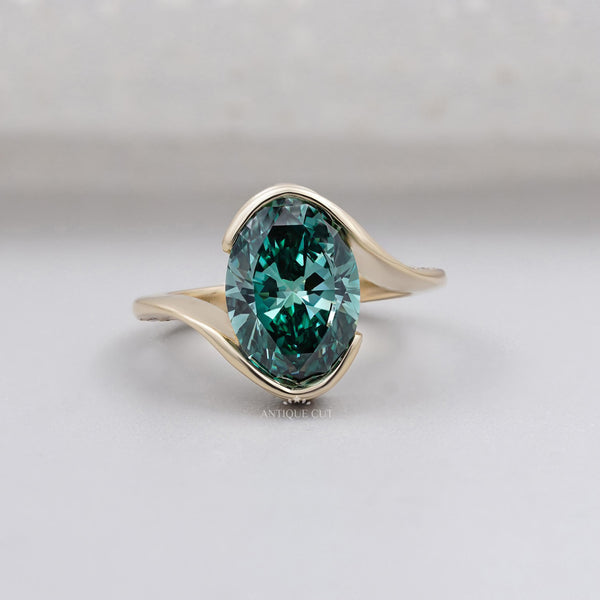
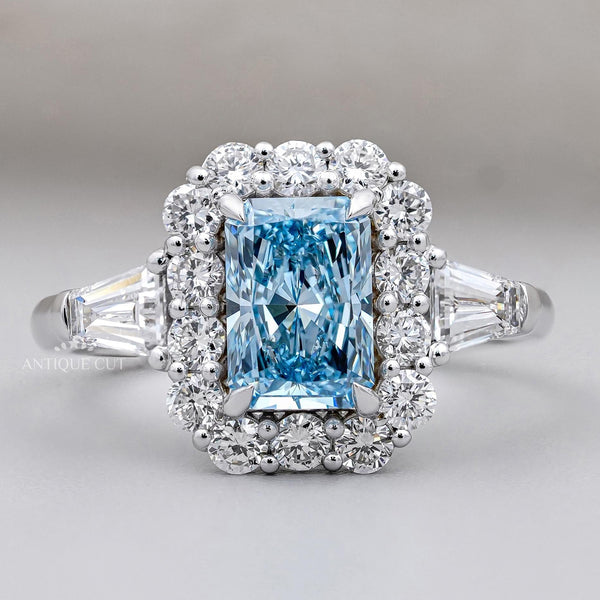
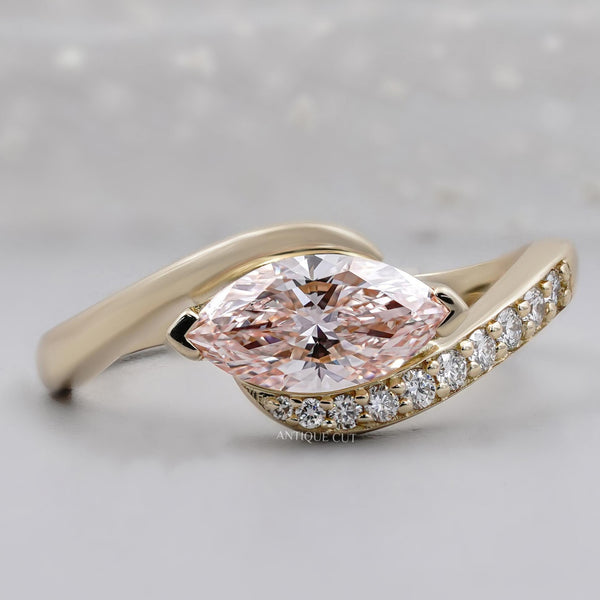
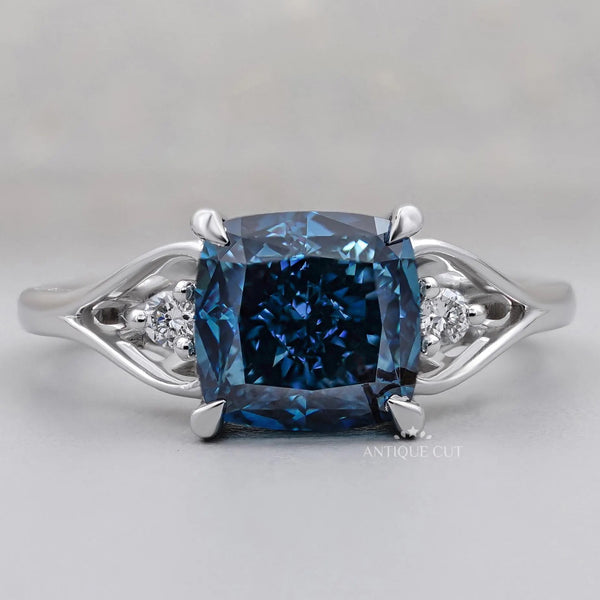
Why Diamond Angles Matter in Jewelry
The angles in a cut gemstone affect more than its outline. They influence how light travels through the crown and pavilion. When crown and pavilion angles work well together, more light can return toward the viewer. Poor combinations may allow light to escape through the bottom or sides.
This does not mean buyers need to calculate every angle manually. A reliable grading report, strong cut assessment, clear videos, and accurate measurements can make the process easier. Angles can also affect durability. Pointed corners on princess, pear, and marquise diamonds require more protection than rounded areas. A setting with V-shaped prongs, standard prongs, or a bezel may help protect these points.
Explore Lab-Grown Diamond Rings with Antiquecut
Understanding diamond anatomy, proportions, and gemstone structure helps you make a more informed choice when selecting a diamond ring. At Antiquecut, every lab-grown diamond ring is created with attention to cut quality, proportions, and detailed craftsmanship.
Whether you prefer a classic round diamond, a refined cushion cut, a radiant shape, or another diamond style, knowing details like the table, crown, pavilion, and what is the girdle of a diamond allows you to better understand the quality behind each design.
Antiquecut focuses on offering carefully selected lab-grown diamonds with certified quality, allowing buyers to explore rings that combine responsible sourcing with skilled jewelry creation. Each diamond is evaluated for important characteristics such as cut, clarity, color, and proportions to help customers find a piece that matches their preferences.
Conclusion
The question how many right angles does a diamond have has two different answers depending on the meaning behind the word “diamond.” In geometry, a diamond shape is usually a rhombus with four equal sides and generally no right angles. A square is the only type of rhombus that has four 90-degree angles.
When discussing a real gemstone, diamonds are evaluated differently. Instead of focusing on sides and angles, experts study diamond anatomy, including the table, crown, girdle, pavilion, and culet. These elements influence the diamond’s proportions, durability, and overall appearance.
Understanding how many sides does a diamond have, what is the girdle of a diamond, and the importance of ideal diamond proportions gives buyers valuable knowledge before choosing a diamond ring. Whether you are exploring a lab-grown diamond engagement ring, a half bezel set ring, or learning more about diamond structure, having the right information helps you appreciate the craftsmanship behind every stone. A half bezel set ring offers a secure setting style that holds the diamond while allowing more of the stone to remain visible, making it a popular choice for buyers who value both design and practicality.
FAQs
1. How many right angles does a diamond have?
A geometric diamond shape, or rhombus, has zero right angles, since its four angles split into two acute and two obtuse pairs.
2. What is the girdle of a diamond?
The girdle is the narrow band around a diamond's widest point, separating the crown above from the pavilion below.
3. Is a diamond shape a square?
A diamond shape may be a rotated square, but it may also be a rhombus or kite. Examine the side lengths and angle measurements to identify the correct geometric shape.
4. Is a thick diamond girdle bad?
A thick girdle is not automatically bad. However, a very thick girdle can hold extra carat weight without contributing much to the diamond’s face-up size.
5. Does every diamond have the same number of facets?
No. Different diamond shapes have different facet arrangements depending on the cutting style.
6. What are ideal diamond proportions?
Ideal proportions refer to the table percentage, depth percentage, and crown and pavilion angles that allow a diamond to return the most light back to the viewer.


