


Among fancy diamond shapes, few are as instantly recognizable as the half moon diamond. With a graceful curved edge on one side and a clean, straight edge on the other, this cut brings architectural elegance to fine jewelry that few other shapes can match. Designers reach for half moon diamonds when they want a piece that feels balanced and intentional whether as a supporting player beside a center stone or as the star of a custom design.
This growing popularity comes down to versatility. A well-cut half moon diamond can frame a center stone, add width to a ring's silhouette, or stand on its own in creative jewelry. In this guide, we'll break down what makes a half moon diamond unique, how half moon cutting works, and what to look for when shopping for a half moon engagement ring, half moon diamond ring, or diamond moon ring. We'll also touch on how Antiquecut approaches this shape in its own designs.
What Is a Half Moon Diamond?
A half moon diamond gets its name from its resemblance to a crescent moon one curved outer edge paired with a straight inner edge, forming a symmetrical, half-circle silhouette. This shape is most often used as an accent stone, sitting alongside a larger center diamond to frame it and add presence to the overall design.
Cutting a half moon diamond takes a careful hand. Because the stone has two very different edges one curved, one straight the cutter has to keep both sides balanced while placing facets in a way that keeps light moving through the stone. Get the proportions wrong, and the stone can look lopsided or lose brilliance. Get it right, and you have a diamond with real presence despite its supporting role.
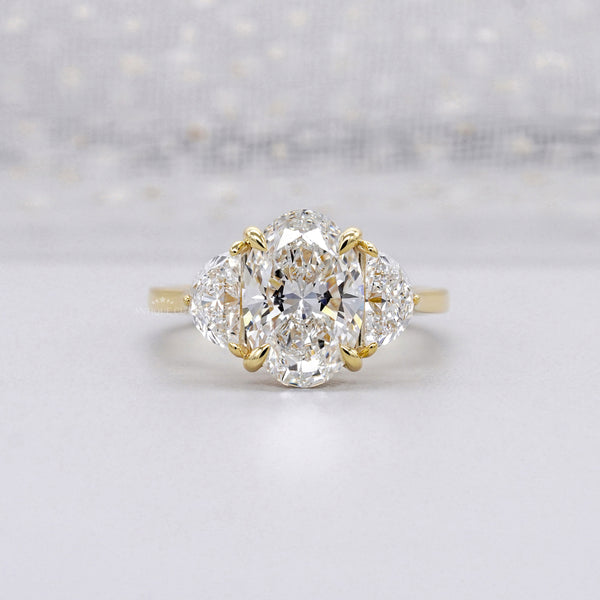

Side stone gold ring


Side stone Two tone ring
The History Behind Half Moon Diamonds
Fancy-shaped diamonds have been part of jewelry design for centuries, but the half moon cut found its footing as cutters and designers looked for ways to move beyond round and square silhouettes. As cutting techniques became more precise, half moon diamonds could be produced with tighter symmetry and better light performance, which made them more reliable and more desirable for fine jewelry.
That reliability has made the half moon a go-to accent stone across price points today. It shows up in high-end custom pieces as well as more accessible options, including lab-grown engagement rings under $1000, where a pair of well-matched half moon side stones can make a modest center diamond look considerably more substantial.
Why Half Moon Diamonds Are Popular
A few reasons this shape keeps showing up in designer collections:
- It looks distinct from traditional round, princess, or cushion cuts
- It pairs well with a wide range of center stone shapes
- It creates a balanced, symmetrical look on the finger
- It adds extra brilliance without competing with the main stone
- It works in both classic and modern jewelry design

Understanding Half Moon Cutting
Half moon cutting is one of the more demanding processes in diamond shaping. Unlike a round or oval cut, where symmetry follows a single consistent curve, a half moon diamond has to balance a curved edge against a straight one and both have to look deliberate, not accidental.
The cutter maps out facet placement carefully, since every angle affects how light enters and exits the stone. Rush the process, and the diamond can end up dull or visibly uneven. Done well, half moon cutting produces a stone with strong light return and a clean, confident outline.
Cut quality in a half moon diamond comes down to a handful of factors:
- Symmetry between the curved and straight edges
- Light return and overall brilliance
- Facet proportions
- Visual balance when paired with a center stone
- Finish and polish
Because these details are harder to get right than in more common shapes, a well-cut half moon diamond is genuinely worth seeking out.
Half Moon Engagement Ring Designs
The half moon engagement ring is probably the most familiar way this shape shows up in fine jewelry. The classic version places two half moon diamonds on either side of a center stone, creating a three-stone ring that adds width and frames the main diamond beautifully.
Benefits of a half moon engagement ring include:
It draws the eye to the center stone. Half moon side stones angle attention inward, making the center diamond look larger and more prominent.
It creates natural balance. Because half moon diamonds are cut and set as mirror-image pairs, the ring reads as symmetrical and intentional from any angle.
It has a distinct silhouette. The curved outer edges give the ring a softer, more sculptural look than standard side stones like baguettes or rounds.
It adds brilliance. The facet structure of a half moon diamond contributes extra sparkle without pulling focus from the center stone.
Custom Jewelry Featuring Half Moon Diamonds
While side-stone settings are the most common use of this shape, a half moon diamond ring can also put the shape front and center. Some designers build entire rings around a single, larger half moon diamond as the focal point a striking option for anyone who wants a fancy shape without going fully round or oval.
The half moon's crescent profile also lends itself naturally to celestial-inspired jewelry. A diamond moon ring, for example, often leans on moon and star motifs, and a half moon diamond fits that theme literally as well as aesthetically.
Beyond rings, the shape shows up across:
- Engagement rings
- Wedding bands
- Earrings
- Pendants
- Anniversary jewelry
- Statement rings
Its adaptability makes it a favorite for custom work, where a client wants something recognizable but not off-the-shelf.
Why Collectors Appreciate Half Moon Diamonds
Beyond engagement rings, collectors are drawn to half moon diamonds because they occupy a distinct niche within fancy shapes. The appeal usually comes down to:
- Unusual geometry that stands apart from mainstream cuts
- The skill required to cut them well
- Strong pairing potential with other stones and shapes
- A balanced, symmetrical look
- Long-term design versatility
For collectors who already have round and cushion cuts covered, a well-cut half moon diamond fills a gap that few other shapes can.
How to Choose a High-Quality Half Moon Diamond
If you're shopping for a half moon diamond ring or considering half moon side stones for a custom piece, a few things are worth checking before you buy:
Symmetry — the curved and straight edges should look deliberate and evenly matched, not lopsided
Matching pairs — if buying two half moon diamonds for a three-stone setting, make sure they're cut as true mirror images of each other
Light performance — look for consistent brilliance across the stone rather than dull or "sleepy" patches
Proportions relative to the center stone — half moon side stones should complement, not overwhelm, the main diamond
Cut quality over carat weight — a smaller, well-cut half moon diamond will outperform a larger one with poor symmetry
At Antiquecut, these details guide how half moon diamonds are selected and set with an emphasis on symmetry, light performance, and how well the stones work alongside the center diamond, rather than treating them as an afterthought.
Conclusion
The half moon diamond has earned its place in fine jewelry through a combination of distinctive shape and genuine versatility. That curved-edge, straight-edge silhouette works as a supporting accent or a standalone focal point, and it shows up comfortably in everything from a half moon engagement ring to a creative diamond moon ring.
Because half moon cutting demands more precision than standard shapes, a well-made half moon diamond ring is a mark of real craftsmanship. For anyone drawn to fancy shapes with a bit of history and architecture behind them, this cut remains one of the more rewarding choices in fine jewelry today.
Design Your Own Engagement Ring
Craft a ring that reflects your story with lab grown diamonds and custom design options.
Explore CollectionFAQS
1. What is a half moon diamond?
A half moon diamond is a fancy cut featuring one straight edge and one curved edge, creating a silhouette that resembles half of a circle.
2. What is a half moon diamond used for?
It's most commonly used as a side stone in engagement rings, framing and enhancing a center diamond.
3. How is half moon cutting different from other diamond cuts?
Half moon cutting balances a curved edge against a straight one, which requires more precise facet planning than symmetrical shapes like round or oval cuts.
4. Are half moon diamonds suitable for engagement rings?
Yes. A half moon engagement ring is a popular three-stone style because the side stones add width and balance around the center diamond.
5. What center stones pair well with half moon diamonds?
Oval, emerald, radiant, cushion, and pear-shaped center stones all pair well with half moon side stones.
6. Can a half moon diamond be the main stone in a ring?
Yes. While typically used as an accent, a half moon diamond can also be the focal point in a custom half moon diamond ring.
7. What makes a diamond moon ring unique?
A diamond moon ring usually draws on celestial themes, and the crescent shape of a half moon diamond fits that concept naturally.
8. Do half moon diamonds look larger than other shapes of similar carat weight?
Their elongated, curved profile can create a broader visual footprint, especially when set beside a center stone.
9. How do I choose a high-quality half moon diamond?
Prioritize symmetry, well-matched pairs, and consistent brilliance over carat weight alone.
10. Why are half moon diamonds popular in fine jewelry?
They offer a distinctive shape, strong design versatility, and a balanced look that few other fancy cuts can replicate.


