

Choosing a diamond isn’t only about size—it’s about knowing what you’re paying for. A diamond color clarity chart helps you understand how diamonds are graded for color and clarity, so you can compare options easily. Instead of guessing, you can see where a diamond stands and make a smarter choice.
Most people don’t need the highest grades to get a good-looking diamond. In everyday use, small differences are often hard to notice, but the price difference can be big. This guide will help you read the chart in a simple way so you can pick a diamond that looks good and fits your budget.
What is Diamond Color and Clarity?
When you look at a diamond, two things affect how it appears at first glance—its color and its clarity. These are part of the basic quality factors used in the diamond industry to judge how a diamond looks and how much it should cost, something we focus on at Antiquecut when helping buyers understand their options.
Color is about how white or tinted the diamond appears. Clarity is about how clean the diamond is inside and on the surface. Both matter, but they don’t always need to be perfect to get a good-looking stone.
What does diamond color mean?
Diamond color refers to how white or slightly tinted a diamond appears. Most diamonds are not completely white—they can have a light yellow or brown tone. The less color visible, the higher the grade.
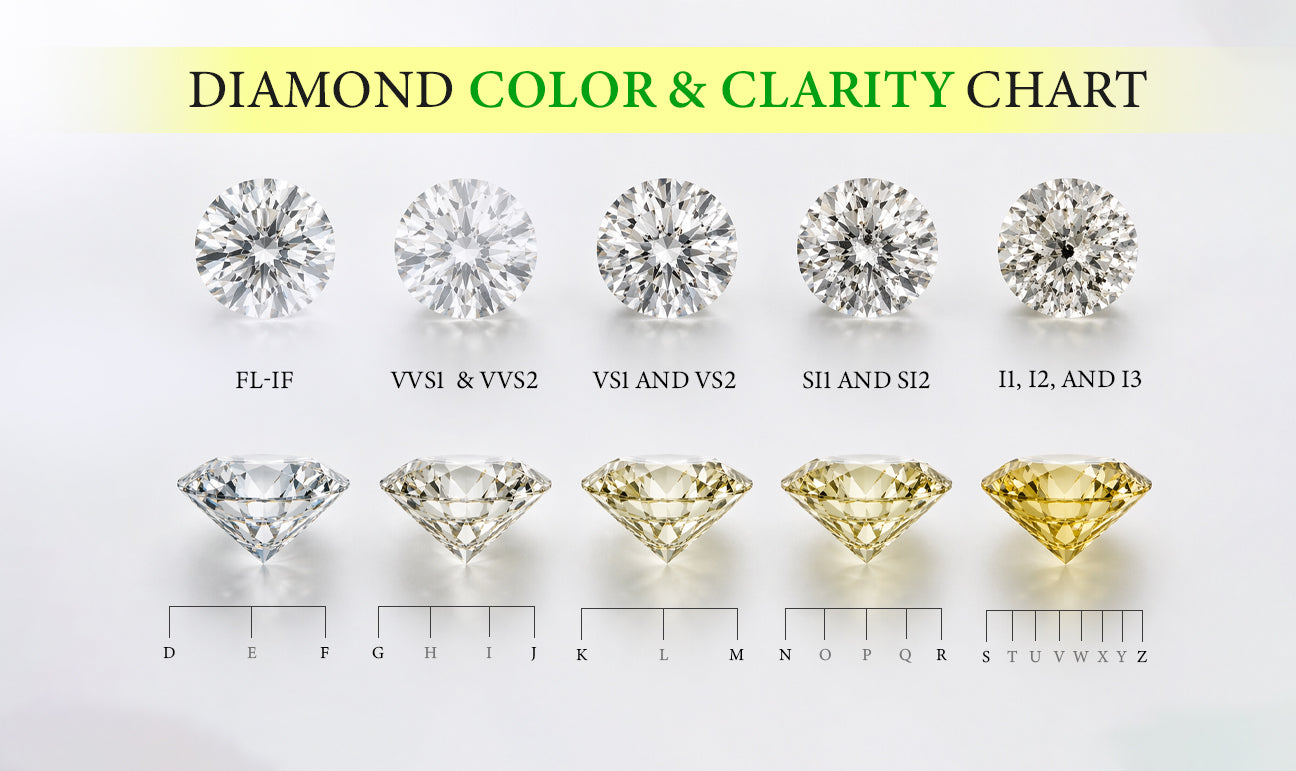
Diamonds are graded on a scale from D to Z:
D–F: Colorless, no visible tint
G–J: Near colorless, still looks white in normal wear
K and below: Color becomes easier to notice
In everyday use, the difference between nearby grades is very small. For example, a G or H diamond can look just as white as a higher-grade diamond once it is set in a ring.
The setting, lighting, and diamond shape can also affect how much color you notice. Because of this, you don’t always need the highest color grade. Many near colorless diamonds offer a good balance between look and price.
What does diamond clarity mean?
Diamond clarity is about how clean the stone is. It looks at tiny marks inside the diamond (called inclusions) and marks on the surface (called blemishes). These form naturally when the diamond is created under the earth.
Most of these marks are very small. In many diamonds, you won’t see them without a magnifying tool. But they still affect how the diamond is graded and how much it costs.
Clarity is not just about whether a diamond has marks—it’s about how visible they are, where they are placed, and how they affect the overall look. For example, a small inclusion near the edge may be less noticeable than one in the center.
For everyday buyers, the key point is simple: if you cannot see the marks with your eyes, the diamond will still look clean. That’s why many people choose diamonds that are not the highest clarity grade but still look clear in real use.
Why both matter together
Color and clarity work together to define how clean and visually appealing a diamond looks. A good balance between the two often gives better value than focusing on just one.
Diamond Color Chart Explained

Color grading scale (D to Z)
Diamonds are graded from D to Z to show how much color they have. D means no noticeable color, while Z means the color is easy to see. This scale helps compare diamonds in a standard way.
Colorless (D–F)
Diamonds in this range have almost no visible color. Even under close inspection, they appear very white. Because they are rare, they are priced higher.
Near colorless (G–J)
These diamonds may have a very slight tint, but it is hard to notice without comparing them to higher grades. In most rings, they still look white, which makes them a popular choice.
Faint to light color (K–M)
At this stage, a small yellow or warm tone can be seen, especially in larger diamonds. Some people don’t mind this look, while others prefer a whiter appearance.
Noticeable color (N–Z)
Diamonds in this range show clear yellow or brown tones. They are usually more affordable and may be chosen by those who prefer a warmer look or are working with a tighter budget.
How color impacts appearance
In daily use, the difference between many color grades is hard to notice. Lighting, diamond shape, and the metal of the ring can all affect how the color appears. For example, a near colorless diamond can still look white once it is set.
Diamond Clarity Chart Explained

Clarity grading scale
Clarity is graded from Flawless (FL) to Included (I). This scale shows how many marks are present and how visible they are.
Flawless (FL) and Internally Flawless (IF)
These diamonds have no visible marks, even under magnification (FL), or no internal marks (IF). They are very rare and usually cost much more.
Very Very Slightly Included (VVS1, VVS2)
These diamonds have very tiny inclusions that are extremely difficult to see, even with magnification. To the naked eye, they appear completely clean.
Very Slightly Included (VS1, VS2)
Inclusions are present but still small. They are hard to see without tools and usually not visible in normal viewing. This range offers a good balance between quality and price.
Slightly Included (SI1, SI2)
Inclusions are easier to find under magnification and may sometimes be visible without it, depending on the diamond. Many SI1 diamonds still look clean to the eye, which makes them a common choice.
Included (I1, I2, I3)
Inclusions are clearly visible and may affect how the diamond looks. In some cases, they can also impact durability. These diamonds are more budget-friendly but need to be chosen carefully.
How to Choose the Right Diamond Using Color and Clarity Charts
Diamond color and clarity charts are useful, but the real goal is to understand where you can save money without affecting how the diamond looks. When you focus only on color and clarity, the idea is simple—choose grades that look good to your eyes, not just on paper.
Focus on color & clarity
Color and clarity charts show very small differences between grades, but many of these are not visible without magnification.
For color:
A D color diamond is completely colorless, but a G or H color can still look just as white in normal viewing. Most people cannot tell the difference unless they compare them closely.
For clarity:
Flawless or VVS diamonds have extremely tiny marks, but even SI1 or VS2 diamonds can look clean to the naked eye. If you cannot see any spots without a magnifying tool, paying more for higher clarity may not be necessary.
The smart approach is to stay in a range where the diamond looks white and clean without going into top grades that don’t show visible improvement.
Match color and clarity together
Color and clarity should be balanced instead of choosing one very high and the other very low.
For example:
- A high color diamond with very low clarity may still show visible marks
- A very high clarity diamond with low color may appear slightly yellow
- A better option is to stay in the middle range for both color and clarity
- This helps the diamond look balanced—white enough and clean enough—without spending extra
Choose grades based on your budget
Color and clarity both affect the price, so even a small change in grade can make a noticeable difference in cost. If you are trying to stay within a budget, it’s better to adjust smartly instead of going for the highest grades.
For example, you can choose slightly lower color grades like G–H instead of D–F, as the difference is hard to notice in real use. For clarity, you can go with grades like VS2 or SI1 where inclusions are not visible to the eye. This way, you avoid paying extra for things you won’t actually see.
This approach works especially well if you are looking for lab grown diamond rings under $1000, where balancing color and clarity helps you get a diamond that looks good without going over budget.
Compare different color and clarity combinations
Charts give you a range, but comparing diamonds helps you understand what those grades really look like.
Try to compare:
- Try comparing two different color grades side by side
- Compare two clarity grades under normal lighting
- You may notice that some lower grades look almost the same as higher ones
- This helps you choose a better option without spending extra
Conclusion:
Understanding the diamond color and clarity chart helps you make a smart choice instead of guessing. You don’t need the highest grades—what matters is how the diamond looks to you and if it fits your budget. Use the chart as a guide, but trust what you see and like.
FAQs
1. Does diamond size affect how color looks?
Yes, bigger diamonds can show color more easily than smaller ones. In small diamonds, slight color is harder to notice.
2. Which diamond shapes hide color better?
Round shapes usually hide color better, while shapes like oval, pear, and cushion may show more tint.
3. Does metal type affect diamond color appearance?
Yes, yellow or rose gold can make a diamond look less tinted, while white gold or platinum can make color more noticeable.
4. Can lighting change how diamond color looks?
Yes, diamonds can look different under sunlight, indoor lights, or warm lighting. Always check in different lighting if possible.
5. What is an “eye-clean” diamond?
An eye-clean diamond means you cannot see any marks or inclusions without magnification.
6. Are clarity inclusions always in the center?
No, inclusions can be anywhere in the diamond. Those near the edges are usually less noticeable.
7. Is it better to choose higher color or higher clarity?
It depends, but many people prefer better color first since it’s easier to notice than small clarity differences.
8. Do lab-grown diamonds follow the same color and clarity grading?
Yes, lab-grown diamonds are graded using the same scale as natural diamonds.
9. Can a diamond’s color change over time?
No, a diamond’s natural color does not change with time.
10. Should I always match color and clarity for earrings or rings?
For earrings, you can go slightly lower in color and clarity since they are less closely viewed than rings.


